SMS vs. Email Marketing: Which Gets Better ROI in 2026?
Everyone has an opinion on this one. Email marketers cite higher ROI per dollar. SMS advocates point to open rates that aren't even close. Both sides pick their numbers carefully — so let's look at the actual data and give you a clear answer.
Short version: SMS wins on speed, immediacy, and response rates. Email wins on depth, nurture, and cost-per-send at high volume. The smartest brands use both. But if you're trying to drive action right now — a reservation, a purchase, a response — SMS isn't a close call.
Open Rates: Not a Fair Fight
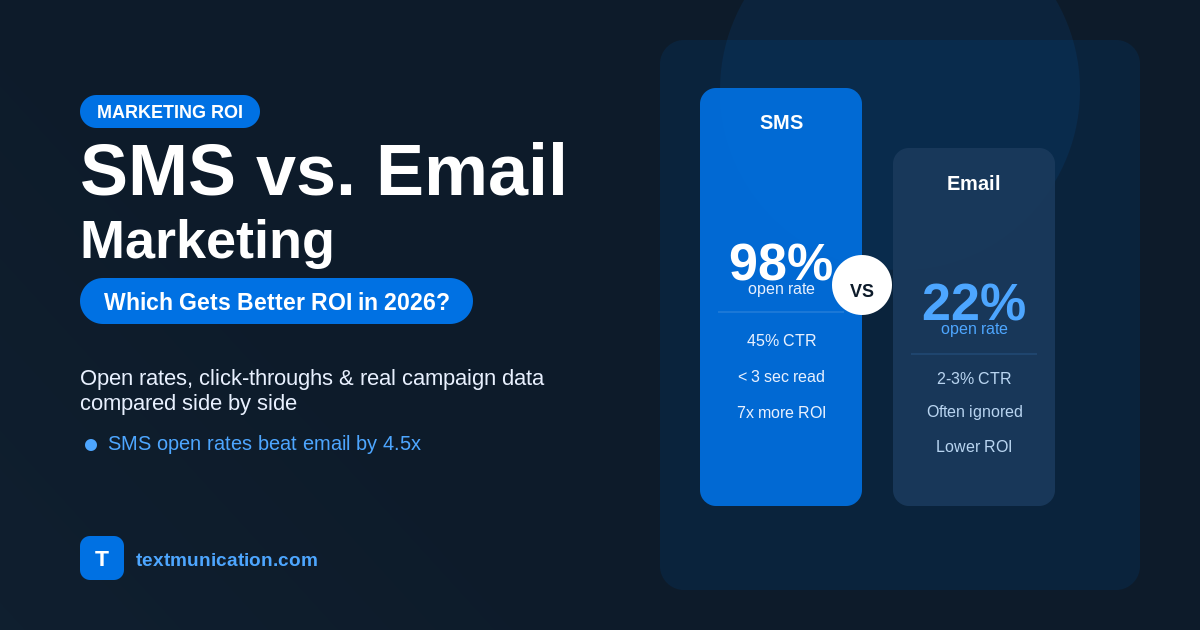
SMS open rate: 98%. Email open rate: 22%. Those numbers get quoted everywhere, and they're accurate — but what drives them matters more than the headline.
SMS messages land in the same place as personal texts from friends and family. No spam folder. No promotions tab. No algorithm deciding whether your message appears. The notification fires, the phone buzzes, and most people look within minutes.
The 3-minute average read time for SMS isn't marketing folklore — it's consistently measured across platforms. Email? Average open time is measured in hours, and that's if it gets opened at all.
For a restaurant pushing a Thursday lunch special, that timing gap is the difference between a full dining room and empty tables. For a retailer with a flash sale that expires at midnight, an email sitting in an inbox until morning is a missed sale. The open rate gap maps directly to revenue in the window that matters.
Response Rates: Where SMS Pulls Further Ahead
Open rates tell you whether someone saw your message. Response rates tell you whether they did something about it.
SMS response rate: 45%. Email response rate: around 6%. That's not a small gap — it's a fundamentally different channel dynamic.
When someone receives a text, replying is the natural behavior. The interface is built for two-way conversation. When someone gets a marketing email, clicking through to a website is a deliberate extra step that most people skip. The friction difference shows up directly in the data.
Healthcare providers who send appointment reminders via SMS see confirmation rates that email simply can't match. No-show rates drop. Staff aren't spending time on follow-up calls. The math is clear once you see it.
Cost Comparison: What You're Actually Paying For
Email Cost Structure
Email marketing has low cost-per-send at volume. Platforms like Mailchimp, Klaviyo, and Constant Contact typically run between $0.001 and $0.003 per email once you're past lower-tier plans. For a 100,000-contact list, that's $100–$300 per send. Cheap — and if your list is engaged and your content is strong, email generates solid returns on that investment.
The hidden costs are list decay, deliverability management, design time, and the ongoing work of staying out of spam filters. A well-run email program requires constant optimization just to maintain performance.
SMS Cost Structure
SMS costs more per message — typically $0.01 to $0.04 per segment depending on volume and provider. That's 10x the per-message cost of email at the low end. For businesses with large lists, that difference is real.
But cost-per-send is the wrong metric. Cost-per-response and cost-per-conversion are what actually matter. When SMS converts at 4–5x the rate of email, the higher per-message cost often results in a lower cost per acquired customer or completed transaction. One SMS campaign that drives 200 in-store visits beats three email blasts that drive 40.
When Each Channel Wins on Cost
For pure high-volume batch communication — monthly newsletters, long-form content, detailed product announcements — email wins on cost. For time-sensitive, high-intent communications where response matters, SMS wins on ROI even at higher per-message rates. Match the channel to the campaign type rather than defaulting to one for everything.
Use Cases Where Email Still Wins
Email is the right channel when you need depth. A 2,000-word onboarding sequence explaining your platform — with tutorials, FAQs, and a welcome video — that's email. SMS can't carry that content, and even if it could, a text message isn't where people go to read and absorb information.
Email also outperforms SMS for long-form nurture sequences for B2B prospects who are 6–12 months from buying, monthly newsletters with industry content and company news, complex transactional communications like invoices and contracts where recipients need to save and reference the document, and re-engagement campaigns to cold audiences where you're building toward action over time.
Email's permanence is a feature in these cases. People save emails, forward them, and come back to them. A text, once read, is usually out of frame within minutes.
Why SMS Wins for Time-Sensitive Offers
If your offer has a deadline — same-day, tonight, this weekend — SMS is the only channel that reliably reaches people in time.
Restaurants: An open table at 5pm needs to be filled by 5pm. SMS gets seen. A push notification might work if the customer has the app and notifications enabled — most don't. Email sits unread until the window is gone. Restaurants using SMS for same-day promotions consistently see fill rates that justify the per-message cost several times over.
Retail: Flash sales, limited inventory alerts, VIP early access — situations where scarcity and timing drive purchase decisions are exactly where SMS outperforms. A clothing retailer texting their top customers about a new drop before it goes live to the general public creates urgency that email can't replicate. The customer opens the text, sees the offer, and acts in the same interaction.
Healthcare: Appointment reminders sent via SMS 24 hours out and again 2 hours out cut no-shows by 30–40% in practices that have made the switch from phone calls and email. Patients respond to confirmation texts in seconds. The same reminder sent by email generates a fraction of that response. For a healthcare practice, that improvement has a direct dollar value — fewer empty slots, less staff time on reminder calls.
The Hybrid Approach: Use Both, Use Them Right
The framing of SMS vs. email as a competition is useful for understanding each channel's strengths, but the most effective marketers aren't choosing one or the other — they're sequencing them.
Lead capture happens across both channels. Someone gives you their email at checkout; they opt in to SMS when they join your loyalty program. You now have two touchpoints to work with.
Email handles the depth layer — welcome sequences, product education, monthly content, nurture for leads who aren't ready to buy. SMS handles the action layer — flash sales, appointment reminders, loyalty offers, time-sensitive alerts.
When both channels are properly segmented and sequenced, they reinforce each other. The customer warmed up by your email content converts faster when they get an SMS offer. The customer who opted into SMS is more likely to engage with your email because they already trust the brand.
At Textmunication, we work with clients across 30+ industries who've built this kind of hybrid program. The ones using SMS alongside email — not instead of it — consistently outperform the ones who've gone all-in on either channel alone. The numbers are clear enough that we don't argue about it anymore.
The Bottom Line
If you're asking which channel has better ROI in 2026, the honest answer is: it depends on what you're trying to do, and the best programs use both. But if your business depends on getting people to take action quickly — book a table, claim an offer, confirm an appointment — and you're not using SMS, you're leaving real money behind.
98% open rate. 45% response rate. Read in under 3 minutes. Those aren't aspirational numbers — they're what you can expect from a well-structured SMS program with proper compliance and targeting.
If you want to see what SMS could do for your specific business, we're happy to walk you through it. No generic pitch — just a real conversation about your industry, your customers, and what a text marketing program would actually look like for you.