SMS/MMS Cart Abandonment Recovery: The 3-Message Sequence That Converts
You built a great product. You drove the traffic. The shopper found what they wanted, added it to their cart — and then vanished.
That's cart abandonment, and it happens to 70% of online shoppers. Not because your price is wrong. Not because your product isn't good enough. Most of the time, shoppers abandon carts because life interrupted them: the phone rang, they got distracted, they decided to "think about it." They had every intention of buying.
Your job is to bring them back before that intention fades. And the single most effective tool for doing that is SMS/MMS.
Why SMS/MMS Outperforms Every Other Cart Recovery Channel
Email cart recovery has been the default for years. The problem is that email recovery rates have cratered as inboxes got more crowded. Average open rates hover around 20%, and those that do open are often doing it hours or days after the cart was abandoned — when the moment has completely passed.
SMS/MMS is a different animal.
98% open rate. Nearly every message you send gets read. Compare that to the 20% you're fighting for in email, and the math becomes obvious: SMS/MMS isn't just better at cart recovery, it's in a different league entirely.
90% of messages are read within 3 minutes of delivery. That speed matters enormously for cart recovery. When a shopper abandons a cart, their intent is still high for the next few hours. SMS/MMS lets you reach them while they're still in buying mode — not the next morning when they've completely moved on.
Average cart recovery rate of 12–15%. That means for every 100 people who abandon a cart, you're bringing back 12 to 15 of them with a well-timed SMS/MMS sequence. At meaningful cart values, that's significant recovered revenue from customers who were already sold on your product.
The data isn't close. If you're running cart abandonment recovery on email alone, you're leaving a large portion of recoverable revenue on the table.
The Psychology Behind the 3-Message Sequence
Most brands make one of two mistakes with cart abandonment: they either send a single reminder and give up, or they blast a discount immediately in the first message.
Both approaches are wrong.
Sending one message is leaving recoveries on the table. Different shoppers respond at different stages — some just need a nudge, some need social proof, and some are discount-driven. A single message only captures the first group.
Discounting in the first message is worse. You're training your customers to abandon carts on purpose to get a deal. You're also cutting into your margin for customers who would have paid full price. And once you establish that pattern, it's nearly impossible to break.
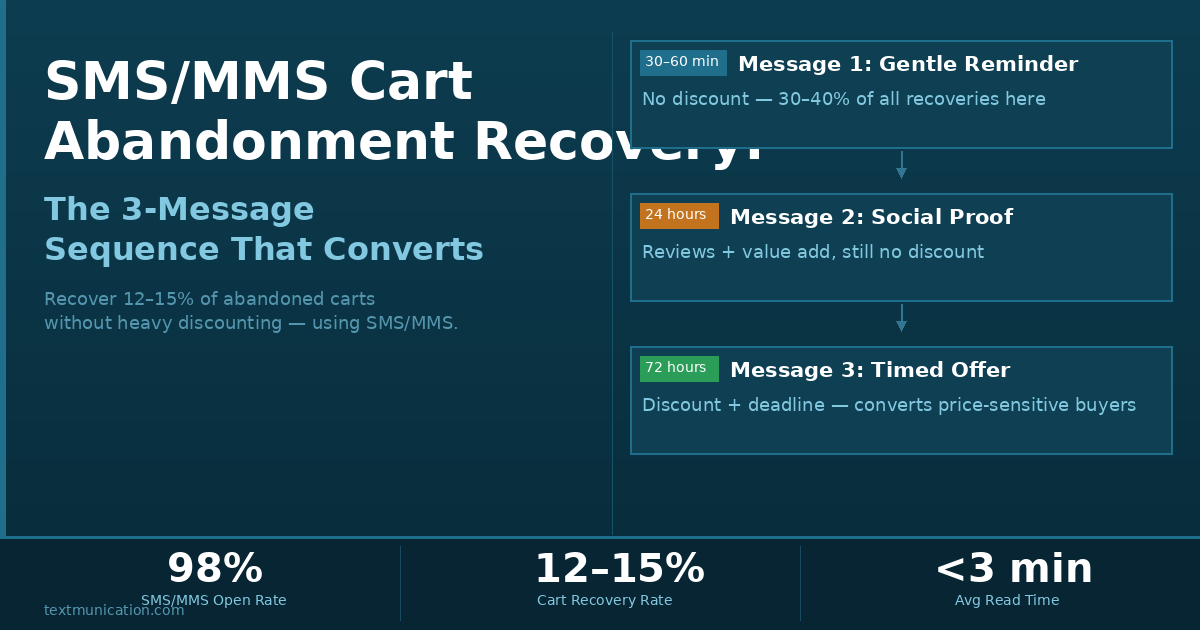
The 3-message sequence solves both problems. It's designed around how buying decisions actually get made:
- Message 1 recovers the distracted buyer who just needed a reminder
- Message 2 recovers the hesitant buyer who needed validation
- Message 3 recovers the price-sensitive buyer with a time-bounded offer
Each message serves a distinct purpose, and together they capture all three groups without over-discounting the first two.
Message 1: The Nudge (30–60 Minutes After Abandonment)
The first message goes out 30 to 60 minutes after the cart is abandoned. This is the highest-converting window in the entire sequence, and it doesn't require a discount.
Why no discount? Because 30–40% of your total cart recoveries will come from this first message alone. These are shoppers who genuinely forgot, got interrupted, or stepped away from their device. They want the product. They just need to be reminded it's there. If you lead with a discount, you're giving margin away to people who would have paid full price.
Template:
Hey [Name], you left something behind! Your [Product] is still in your cart at [Store]. Grab it before it sells out: [Link]
Reply STOP to opt out.
Keep it simple. Personalize with the shopper's name and the specific product — that personal relevance is what gets the tap. The urgency of "before it sells out" adds a light nudge without feeling manipulative. And the opt-out language isn't just a best practice, it's required.
What to optimize here: The link should go directly to the cart with items pre-populated, not the homepage. Every additional click you add between this message and checkout is recovery you're losing. Make the path from tap to purchase as short as possible.
Message 2: Social Proof and Value (24 Hours After Abandonment)
If Message 1 didn't convert, you're dealing with a more hesitant buyer. They saw your reminder. They thought about it. They didn't pull the trigger. What they need now isn't another nudge — they need validation.
This is where social proof does the heavy lifting.
Template:
Still thinking it over? 847 customers gave [Product] 5 stars this month. Free shipping on orders over $50. Your cart: [Link]
Reply STOP to opt out.
Notice what's not in this message: a discount. You're still not discounting because there's a meaningful group of buyers who just needed to see that other people love this product. Social proof — real review numbers, not generic claims — builds the confidence that was missing the first time.
The "free shipping" mention is a value add, not a price cut. You're adding value to the purchase without reducing your margin. If you already offer free shipping above a threshold, mention it here. If you don't, this is also a good place to surface any existing value proposition: free returns, a satisfaction guarantee, or a loyalty program.
Timing matters here. 24 hours gives shoppers time to sleep on the decision without losing the thread entirely. Any shorter and you risk feeling aggressive. Any longer and they've mentally moved on.
Message 3: The Offer with a Deadline (72 Hours After Abandonment)
By 72 hours, you've filtered down to your price-sensitive segment — shoppers who want the product but haven't been able to justify the purchase yet. This is the right time to bring out a discount, but it needs to be structured carefully.
Template:
Last chance! Use CART10 for 10% off your [Product] — expires midnight tonight. Complete your order: [Link]
Reply STOP to opt out.
Two things make this message work: the offer and the deadline. The offer (10% off is a reasonable starting point — significant enough to move the needle without gutting your margin) answers the price objection. The deadline ("expires midnight tonight") creates genuine urgency that drives same-day decisions.
Never send an "expires" message without an actual expiration. If you let the code work after midnight, you're training buyers to wait out your urgency messages. The deadline has to be real, and when it passes, the offer has to go away. That consistency is what makes future urgency messages believable.
On discount depth: 10% is usually enough for this segment. Resist the urge to go to 20% or free shipping as a default — start conservative and test. You may find 10% converts just as well as 20%, at half the margin cost.
Setting Up Compliance Before You Launch
Before you send a single cart recovery message, compliance has to be in place. This isn't optional and it's not bureaucratic overhead — it's what keeps your messages delivering and your business protected.
Explicit opt-in is required. Under TCPA regulations, you must have prior written consent to send marketing SMS/MMS messages. "Prior written consent" means the shopper actively agreed to receive texts from you — not just completed a purchase, not just provided a phone number. The consent must be explicit, specific, and documented.
The right place to capture this is during checkout: a clearly labeled checkbox (unchecked by default) with language like "I agree to receive SMS/MMS marketing messages from [Store]. Message & data rates may apply. Reply STOP to opt out." That checkbox, with a timestamp and the phone number it's tied to, is your consent record.
10DLC registration is mandatory for any meaningful volume. The major carriers — AT&T, T-Mobile, Verizon — require brands to register their messaging campaigns through The Campaign Registry before those campaigns go live. Unregistered traffic gets filtered. If you're sending cart abandonment messages at scale and you're not registered, your messages are likely getting blocked and you don't know it.
Opt-out language in every message. Every single SMS/MMS you send needs an opt-out path. "Reply STOP to opt out" isn't optional language — it's required. When a customer texts STOP, that opt-out must be honored immediately and permanently.
Maintain your suppression list. Every number that opts out goes on a suppression list and never gets messaged again, regardless of future purchases. This list has to be active and current at all times.
These aren't edge-case requirements. They apply to every brand, every campaign, every message.
How to Build This in SAM
Textmunication's SAM platform is built to run exactly this kind of sequence without manual intervention. Once you configure the workflow, every qualifying cart abandonment triggers the sequence automatically.
Here's how the setup works:
Step 1 — Connect your eCommerce platform. SAM integrates with Shopify, WooCommerce, BigCommerce, and custom platforms via webhook. The integration watches for cart creation events and tracks whether a purchase is completed within your trigger window.
Step 2 — Define your trigger window. Set the time threshold after which an unpurchased cart is considered abandoned. Most brands use 30–60 minutes. The trigger should only fire if no purchase has been completed and no other active sequence is already running for that contact.
Step 3 — Build the three-message flow. Create each message node in the sequence with its specific delay (0 minutes, 24 hours, 72 hours from trigger), template content, and personalization tokens. Each message should include your product link with UTM parameters so you can track which message drove the conversion.
Step 4 — Set exit conditions. The sequence should exit immediately when a purchase is completed. If someone buys after Message 1, they should never receive Messages 2 or 3. This requires a real-time purchase listener — SAM handles this natively, but if you're building on a different platform, this is a critical requirement that's often missed.
Step 5 — Configure compliance. Load your suppression list before launch. Verify your 10DLC registration is active. Confirm opt-in timestamps are being captured and stored at checkout. SAM includes built-in opt-out processing and suppression management, but you need to verify these are active before your first message goes out.
Step 6 — Test end-to-end. Run a complete test with a real device before going live. Add a product to cart, trigger the sequence, and verify each message arrives with the correct content, correct timing, and correct links. Click through to checkout and verify the cart is pre-populated. Confirm opt-out works as expected.
What to Measure After Launch
Recovery rate is the headline number, but it's not the only metric that matters.
Recovery rate by message. Break down which message in the sequence is driving the most conversions. Most brands see 30–40% of recoveries from Message 1, another 30–35% from Message 2, and the remainder from Message 3. If Message 1 is dramatically underperforming that range, your timing may be off or your link isn't going directly to cart.
Opt-out rate. A healthy opt-out rate for a well-targeted recovery sequence is under 2%. If you're seeing higher than that, your messaging frequency is too aggressive or your opt-in capture isn't selective enough.
Discount redemption rate on Message 3. Track how many people use the CART10 code. If redemption is extremely high (above 50%), you may be able to offer a smaller discount and get similar conversion. If it's very low (under 5%), the timing or offer structure may need adjustment.
Revenue per recovery. Average order value for recovered carts compared to standard order value. Cart abandonment customers sometimes have higher AOVs because they were in the process of buying something specific they wanted — track this to understand the real value of the program.
The Compounding Effect Over Time
Cart abandonment recovery isn't a one-time win — it compounds.
Every month you run the sequence, you're recovering revenue that would otherwise be permanently lost. That recovered revenue pays for your messaging platform, your compliance costs, and more. But the bigger compounding effect is the data.
After 90 days of running the sequence, you'll have real conversion data across all three messages for your specific audience, product catalog, and price points. You'll know which message timing converts best, what discount threshold moves your price-sensitive segment, and which products have the highest abandonment-to-recovery rate.
That data becomes the foundation for every optimization — and for building out the next tier of your SMS/MMS automation beyond cart recovery.
Ready to Set Up Your Recovery Sequence?
A properly configured SMS/MMS cart abandonment sequence with compliant opt-in capture, 10DLC registration, and a three-message flow is one of the highest-ROI marketing automations you can run for an eCommerce business.
Textmunication handles the platform, the compliance infrastructure, and the 10DLC registration so you can focus on the messaging strategy rather than the technical setup. Our team has built cart recovery sequences across retail, fitness, food and beverage, and direct-to-consumer brands — we know what works and what doesn't.
Get started with a cart abandonment recovery consultation and we'll walk you through exactly how to set this up for your store.